|
Hyperthyroidism is an important
clinical consequence
of multinodular goitre and a
characteristic manifestation
of the disease. The importance
of iodine intake for the
development of the disorder,
even in non-endemic areas
has been demonstrated in
comparative epidemiological
studies in Jutland, Denmark
with mild to moderate
iodine deficiency (but no
endemic goitre in school
children) and Iceland with a
high normal iodine intake.
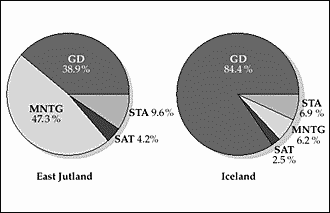
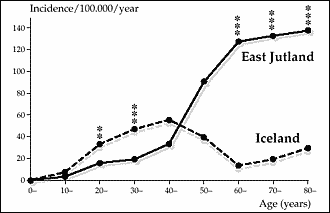
Fig. 6 shows the contribution of various types of disease to the incidence of hyperthyroidism in the two areas. Multinodular toxic goitre was the most common type in the low iodine intake area, whereas it was the cause of only 6 % of cases in the high iodine intake are. In Iceland the dominating cause of hyperthyroidism was Graves’ disease, and in young subjects the incidence was several fold higher than in Jutland. The life time risk of developing Graves’ disease was not much different as this was more common among the elderly in Jutland. Still, the dominating cause for the very high incidence of hyperthyroidism in the elderly in Jutland was multinodular toxic goitre (fig. 6). Figure 6a:
Figure 6b:
|