|
Functional autonomy with thyroid hormone syn-thesis
and secretion even in the absence of TSH is
a characteristic feature of multinodular goitre.
Hyperfunctioning areas may develop as nodules
or be scattered in internodular tissue (fig. 4).
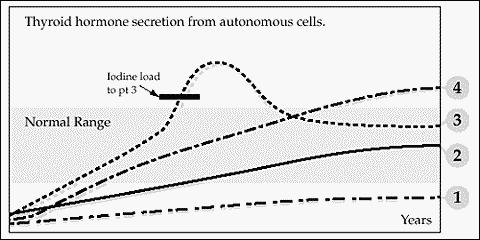
Autonomous thyroid hormone secretion tends to increase gradually over years with a concommittant decrease in pituitary TSH secretion. This keeps the patient euthyroid. The balance can be disturbed by a sudden iodine load to the patient leading to transient hyperthyroidism (fig. 5). Figure 5:
Even without an iodine load the disease tends to proceed, with a course varying widely between patients. Different patterns of disease progression towards hyperthyroidism are illustrated in fig. 5. |