|
Your thyroid gland is a
small gland, normally weighing less than one ounce, located in the
front of the neck. It is made up of two halves, called lobes, that
lie along the windpipe or trachea and are joined together by a
narrow band of thyroid tissue, known as the isthmus, just below
your "Adams apple" or larynx. During development the thyroid gland
originates in the back of the tongue, but it normally migrates to
the front of the neck before birth. Sometimes it fails to migrate
properly and is located high in the neck or even in the back of
the tongue (lingual thyroid). At other times it may migrate too
far and ends up in the chest (substernal thyroid).
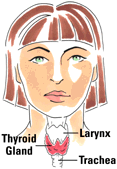
The function of the thyroid gland is to take iodine, found in many foods, and convert it into thyroid hormones: thyroxine (T4) and triiodothyronine (T3). These hormones are then released into the blood stream and are transported throughout the body where they control metabolism (conversion of oxygen and calories to energy). Every cell in the body depends upon thyroid hormones for regulation. The normal thyroid gland produces about 80% T4 and about 20% T3; however, T3 is about four times as strong as T4.
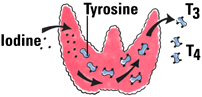
Thyroid Gland making Thyroid Hormone The thyroid gland is under the control of the pituitary gland, a small gland the size of a peanut at the base of the brain. When the level of thyroid hormones drops too low, the pituitary gland produces THYROID STIMULATING HORMONE (TSH) which stimulates the thyroid gland to produce more hormones. This raises the blood level of T4 and T3, and the pituitary TSH level then decreases. One can imagine the thyroid gland as a furnace and the pituitary gland as the thermostat. Thyroid hormones are like heat. When the heat gets back to the thermostat, it turns the thermostat off. As the room cools (the thyroid hormone levels drop), the thermostat turns back on (TSH increases) and the furnace produces more heat (thyroid hormones).
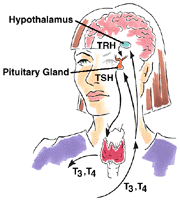
Thyroid Feedback Mechanism The pituitary gland itself is regulated by another gland, known as the hypothalamus. The hypothalamus is part of the brain and produces TSH Releasing Hormone (TRH) which tells the pituitary gland to stimulate the thyroid gland (release TSH). One might imagine the hypothalamus as the person who regulates the thermostat since it tells the pituitary gland at what level the thyroid should be set. |


