|
This review is based mostly on the compilation of publications in peer reviewed
journals and occasionally on information kindly provided as personal communications
by prominent personalities in the field of IDD in the different European countries.
These colleagues are usually also the national focal points of ICCIDD in their
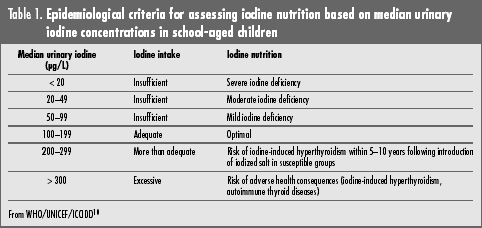
respective countries. This paper provides also updated information on the regulations governing the use of iodized salt and marked shares of iodized household salt in Western and Central Europe. For this part, the information has been largely collected by Mr. Bernard Moinier, Secretary of the European Salt Producers Association, ESPA. Generally speaking, the part of the present review on Western and Central Europe constitutes a further development of a preliminary report on IDD in Europe prepared by F. Delange, H. Bürgi and B. Moinier and which is presently in press. The information on IDD and its control in Eastern Europe has been kindly provided by Doctor Gregory Gerasimov. This review paper provides essentially clinical data such as the prevalence of goiter and the urinary iodine concentrations. Thus, it evaluates the present status of iodine nutrition. It will conclude that a country can be considered as iodine sufficient if, based on a national survey, the prevalence of goiter in the country is below 5 % and the median urinary iodine is within the normal range, i.e. between 100 and 200 µg/l10 (Table 1). A median above 200 µg/l is more than adequate with possible risks of side effects. The data presented in this report will not allow to state that iodine deficiency has been eliminated in a given country as the criteria proposed by WHO, UNICEF and ICCIDD10 for reaching this conclusion are more exhaustive, including a proportion of household using adequately iodized salt above 90 %, less than 50 % of the urine samples containing below 100 µg/l iodine and at least 8 of 10 programmatic indicators dealing essentially with the administrative and political aspects of the organization of the programs at country levels. Interestingly enough, the prevalence of goiter has even disappeared from these criteria, essentially because the emphasis is put on the implementation of programs of iodized salt and probably also because of the uncertainties on the criteria used for establishing universal normative values for thyroid volume measured by ultrasound, and consequently for estimating the prevalence of goiter13.
|