|
Autoimmune thyroid disease commonly leads to
goitre. Most patients with Graves’ disease (about
80 %) have a diffuse goitre. This is presumably
due to thyroid cell proliferation induced by activation
of the TSH-receptor by TSH-receptor
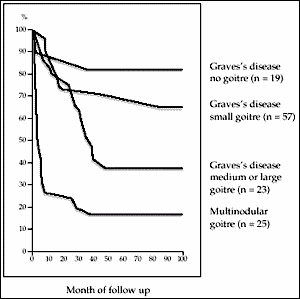
autoantibodies. The larger the size of the thyroid
in hyperthyroid Graves’ disease, the less favorable
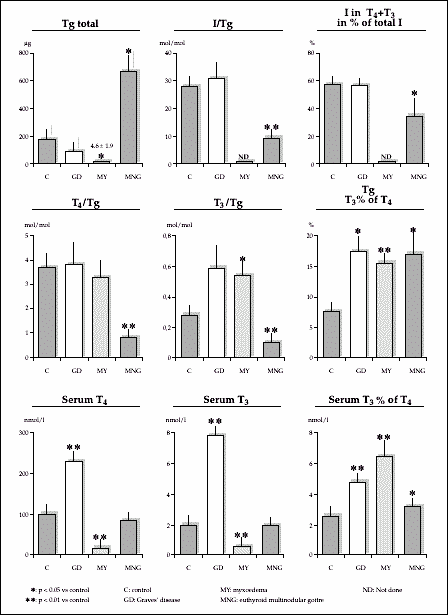
the response to medication (fig. 2) The follicular
cells of Graves’ disease react to the chronic
stimulation by an increase in T3 synthesis in thyroglobulin
and by a high rate of T4 deiodination
to T3. This high T3 state (fig. 3) is a normal and
reversible reaction.
Figure 2:
Figure 3:
Approximately 15 % of patients with autoimmune hypothyroidism have goitre (Hashimoto’s disease), but the majority have atrophic thyroiditis. The main cause for the goitre in Hashimoto’s disease is excessive accumulation in the thyroid gland of lymfocytes. This type of goitre may occur with normal or only slightly impaired thyroid function. The follicular cells in autoimmune hypothyroidism are more or less stimulated by TSH. They react similarly to stimulation as the follicular cells in Graves’ disease (fig. 3). Hence, the functional defect in autoimmune hypothyroidism seems to be caused by a reduction in the number of functioning cells, and not by inade-quate function of the single cell. |