|
The most common cause of a solitary focal
enlargement of the thyroid gland is neoplasia.
Typically it is a benign monoclonal process. In
few per cent of cases it is a malignant tumor. The
surrounding thyroid tissue is normal except that
scattered microscopical nests of tumor may be
found in some patients with cancer.
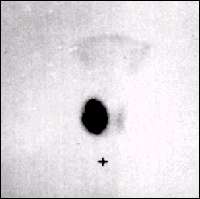
Solitary benign thyroid neoplasias may harbour autonomous function with the ability to synthesize and secrete thyroid hormones independent of TSH. In the majority (but not all) of such nodules somatic mutations have been demonstrated activating the TSH receptor or Gs-alpha protein, leading to unregulated activation of the adenylyl cyclase-cAMP cascade. When the amount of thyroid hormones secreted from the neoplasm exceed the fysiological needs, the patient becomes hyperthyroid. Fig. 1 shows a typical scintigram with a circumscribed solitary hot nodule and suppression of surrounding normal thyroid tissue. More commonly the cells of the neoplasm have lost the ability to accumulate iodine and/or synthesize thyroid hormones. This gives the clinical picture of a solitary cold nodule. Presumably other types of somatic mutations are involved in the generation of such nodules. Figure1:
|