|
IntroductionHyperthyroidism refers to excess thyroid hormone in the blood. Symptoms are due to increased metabolism caused by thyroid hormone. Virtually every cell in the body requires thyroid hormone for normal metabolism to convert oxygen and calories into energy. When there is an excess of thyroid hormone, metabolism is "speeded up". Initially, there seems to be too much energy, but this paradoxically leads to exhaustion because the body is unable to "store energy". Patients sometimes complain that their "get up" does not keep up with their "want to". The symptoms relate to this "increase in metabolism" and "inability to store energy".Because of the widespread news coverage of former President and Mrs. Bush having Graves' Disease, the general public is more aware of the typical symptoms and the treatment using radioactive iodine. The publicity of Graves' Disease in professional golfers, Ben Crenshaw and Pat Bradley, have educated the public how debilitating the disease can be and also emphasized the complete recovery that is possible when the disease is properly treated.
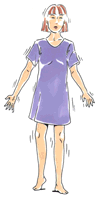
A. Symptoms of HyperthyroidismSymptoms of hyperthyroidism are usually mild at first and get progressively worse. Symptoms are vague and diffuse and usually blamed on "emotional" problems or a little hyperactivity.
1. Rapid Heart BeatGenerally patients notice increase in heart beat before they notice an increase in other things. It may be irregular or just fast. Sometimes the rate is normal but the heart seems to beat harder (palpitations).
2. False Energy and FatigueThis "false energy" is sometimes more noticeable to friends and relatives than to the patient (the person seems "hyper"). The chronic fatigue comes from the inability of the cells to store energy and the loss of reserve energy.
3. Weight LossWeight loss may occur in spite of good or increased appetite. This is extremely variable and depends upon appetite, lack of sleep, and activity, with patients occasionally losing up to one-third of their body weight. More commonly, the weight loss is limited to 10-20 pounds and some patients (10-15%) will actually gain weight because they are so tired that they decrease their activity. (Weight gain is common in people who are "hyperthyroid" from taking too much thyroid medication).
4. Loss of SleepEither difficulty getting to sleep or waking up and being- unable to go back to sleep (restlessness) is very common. Patients usually wake up as tired as they went to bed because their body's metabolism does not slow down during sleep as it does in people whose thyroid gland is functioning normally.
5. Nervousness and IrritabilityThis is very common; again, sometimes this is more noticeable to relatives and friends than it is to the patients. Sometimes, a shakiness develops known as a "thyroid tremor".
6. Heat IntoleranceSensitivity to heat occurs frequently. Sometimes patients tolerate this well in the winter months and it does not become a problem until hot weather arrives.
7. Hair ChangesThe hair seems to get thinner and come out faster. It also grows faster, does not hold a permanent as well, and becomes more difficult to manage. (Hair loss can also occur with too little thyroid).
8. Increased frequency of bowel movements or episodes of diarrheaSometimes this is just a change from constipation to normal bowel habits.
9. Decrease in Menstrual PeriodsSkipping periods or decrease in number of days frequently occurs in women who are hyperthyroid. Men may experience a decrease in their sex drive (libido).
10. Muscle WeaknessWeakness of muscles occurs when hyperthyroidism has been present for a prolonged time. Hyperthryoidism is uncommon in children, but can occur. The symptoms are similar to those in the adult and the child may appear to grow faster than normal. Grades in school drop because of decreased attention span. Older people may not show the usual manifestations seen in other patients. They frequently seem to be apathetic rather than nervous. Irregular or rapid heart beat with heart failure may be the only sign of hyperthyroidism in the elderly. In any given patient, the symptoms are extremely variable. Very few patients with hyperthyroidism will show all the above symptoms. Sometimes, only one or two of the symptoms will be present. The final diagnosis always depends upon appropriate abnormal thyroid tests.
B. Causes of Hyperthyroidism1. Graves' DiseaseGeneralized over activity of the entire gland usually associated with an enlargement. This disease was first recognized by the Irish physician Dr. Robert Graves in the 19th century. On thyroid scan the entire gland takes up too much iodine and produces too much T4 and / or T3. About 60% of patients will have a bulging of the eyes known as exophthalmos which does not occur with the other causes of hyperthyroidism.Exophthalmos may occur before, simultaneously with, or after the hyperthyroidism of Graves' Disease. It cannot be produced in people by giving thyroid pills and is probably the result of whatever causes the gland to become hyperactive. In its mildest form it may produce prominent eyes or a "thyroid stare". Patients frequently complain of "sand in the eyes" or increased sensitivity to sunlight and flourescent lights (photophobia). Patients who wear contact lenses will find they cannot tolerate them. Increased tearing or drying may occur. Diplopia or double vision is common. Loss of vision has occurred, but is extremely rare. For unknown reasons, eye problems are much more frequent in patients who smoke cigarettes than in those who do not. While most patients are only minimally bothered by the eye changes, other patients will have moderate involvement that is helped by wearing sunglasses, using eye drops (for dryness) and avoiding dust and pollen. Diplopia can be corrected by wearing prisms in the glasses, patching one eye, or surgery on the eye muscles. Fortunately, surgery is rarely necessary.
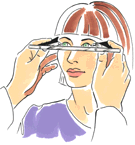
Measuring for Exophthalmos The cause for Graves' Disease remains unknown, but in a large proportion of patients there is a family history of other family members who have Graves' Disease or Hashimoto's thyroiditis. Although surgery (thyroidectomy) was the only treatment available for Dr. Graves' patients, it is seldom done today because of the risk, the discomfort, and the expense involved. Many patients who were treated surgically in the past return years later with recurrent disease in the remaining thyroid gland. In 1944 the first antithyroid medication (Propylthiouracil or PTU) was made available, followed by Methimazole in 1952. These medications "slow down" the thyroid gland. They only work while being taken, and the majority of patients become hyperthyroid again when they are stopped. Sometimes a remission may occur on the medication, but these patients usually redevelop disease at some future date. Because severe allergic reactions to these medications can occur, even causing death, they are being used less frequently today. The treatment of choice for Graves' Disease today is radioactive iodine 131. First used in the early 1940's it has proven even more effective than surgery in controlling hyperthyroidism. It is given by mouth as a medication (usually one dose is sufficient) and, like surgery, removes all or part of the thyroid gland. The dose given is determined by the radioactive iodine uptake and the size of the gland on the computerized rectilinear scan. Approximately 50% of patients so treated will need to be on thyroid replacement within one year of treatment. It is important that patients treated with radioactive iodine be followed closely that first year and annually thereafter so that thyroid replacement can be started if the gland becomes under active. Occasionally (5% of the time) a patient needs a second dose of radioactive iodine 131 if the first dose not completely control the hyperthyroidism. The second treatment is never given until after three months to allow adequate time for the first dose to work. Radioactive iodine 131 takes approximately six weeks to start working and is therefore not as quick as surgery. However, when one adds the time to prepare a patient for surgery and the recovery from surgery, the time is about the same. Radioactive iodine 131 is not given to pregnant women and it is recommended that patients treated with radioactive iodine use birth control for three months after treatment. Extensive follow up of thousands of patients treated since 1946 has yielded no increase incidence of thyroid cancer or any other type of cancer in patients whose Graves' Disease was treated by radioactive iodine. Children born to mothers who were treated with radioactive iodine have shown no increase incidence of birth defects. The radioactive iodine is absorbed from the stomach into the blood and concentrates in the thyroid gland. The remaining radioactive iodine is excreted in the urine. The radiation exposure to the ovaries and testicles is similar to the amount one gets from diagnostic x-ray procedures such as an IVP and barium enema x-ray. Radioactive iodine does not increase chances of infertility. Indeed, the relative infertility caused by hyperthyroidism suddenly disappears when patients get treated, and patients frequently become pregnant a few months after treatment. People who felt they did not "need to worry about birth control" suddenly found themselves very fertile after treatment. Therefore it is recommended that all patients use birth control for at least three months after radioactive iodine. This keeps one from getting pregnant in case a second dose of radioactive iodine should be needed and allows time for the radioactivity to disappear from the body. Most patients are treated as outpatients and do not require hospitalization. In our Clinic alone, about 250 patients are treated annually. After the dose of radioactive iodine that is to be given is calculated, a capsule containing that dose of radioactive iodine is made and given to the patient to swallow. The patient usually does not notice anything (no pain or swelling) after taking the pill. In fact, many patients are skeptical that such a small dose of medicine will do anything. In order to not expose others unnecessarily to radiation we recommend that patients minimize the time spent around pregnant women and young children for five days. Breast feeding is prohibited. To avoid contamination, patients should use separate bath linens and eating utensils during this five days. Rinsing the sink and tub and flushing the toilet three times after use also helps decrease the risk of contaminating others. Drinking plenty of water helps flush the extra radioactive iodine from the body. There will be no improvement in the hyperthyroidism until about six weeks later; therefore, patients should get as much rest as possible and stay on an adequate diet during this time. Beta blockers such as Inderal serve as antidotes to block the effects of excess thyroid hormone. These drugs are frequently used during this waiting period to control symptoms, and they can be tapered off after six weeks when the radioactive iodine has corrected the hyperthyroidism. The actual size of the thyroid gland should be noticeably decreased by the end of the third month.
2. Toxic nodulesToxic nodules (single or multiple) are less common causes of hyperthyroidism than Graves' Disease. They tend to occur in an older age group and there is no hereditary etiology known. Most important, exophthalmos does not occur with this variety of hyperthyroidism. Again, treatment can be with radioactive iodine or surgery. Antithyroid medications have not been very helpful in controlling this variety of hyperthyroidism.
3. ThyroiditisAll types of thyroiditis (Hashimoto's, De Quervain's or silent thyroiditis) can present with hyperthyroidism initially but later develop normal thyroid function or hypothyroidism. Neither radioactive iodine, surgery, or antithyroid medicine is needed for treatment.
4. MedicationThe indiscriminate use of thyroid hormone in the past for weight loss, "tiredness:, infertility, etc. lead to many people getting hyperthyroid from taking unnecessary thyroid hormone. Although the blood levels are high, radioactive iodine uptake in the thyroid is very low because the thyroid is not making hormone. Treatment is to discontinue the thyroid medication.The recent release of a new drug for cardiac arrhythmias, Amiodarone or Cordarone, has resulted in an increased incidence of hyperthyroidism. The hyperthyroidism disappears six-eight weeks after the drug is discontinued. High doses of iodine can also cause this type of hyperthyroidism. Iodine can be found in kelp (seaweed) which is used in many "diet foods" or supplements distributed by "health food stores". Again, the hyperthyroidism disappears several weeks after the iodine is stopped. |


