|
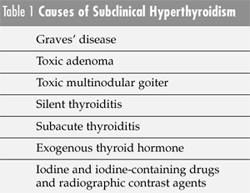
The causes of subclinical hyperthyroidism are
similar to those that cause overt thyrotoxicosis 2 .
(Table 1). In iodine-sufficient regions such as the
United States, overt hyperthyroidism in women of
all ages is most commonly due to Graves’ disease,
and early Graves’ disease may present as subclinical
hyperthyroidism. Multinodular or uninodular
toxic goiter is another major cause of subclinical
hyperthyroidism, especially in areas of marginal
iodine intake. The natural history of multinodular
goiter (Plummers’s disease) appears to be the
gradual development of autonomy, leading first to
subclinical and then to overt hyperthyroidism 3 .
The prevalence of thyroid nodularity generally
increases with age, especially in women. In one
English post-mortem study 23 % of women over
age 60 had nodular glands 4 . A German post-Merck
mortem study (in an area of moderate iodine deficiency)
found nodules in 88 % of elderly women 5 .
Subclinical hyperthyroidism must be differentiated from other causes of low serum TSH values including non-thyroidal illness, pregnancy, pituitary or hypothalamic insufficiency, and the use of medications including glucocorticoids, dopamine, aspirin, furosemide, and fenclofenac 6 . A suppressed TSH may be a transient finding. For example, in the Framingham Heart Study, 88 % of those who had subclinical hyperthyroidism at baseline had serum TSH values > 0.1 on repeat testing four years later 7 . |