|
Pre-toxic or toxic thyroid adenoma
This is one of the main indications for PEI treatment 6–9,13–15,18–21 . The purpose of PEI treatment is to restore normal serum FT 4 , FT 3 and TSH concentrations and to shrink the volume of the adenoma; as a matter of fact cured pre-toxic or toxic (”hot”) adenoma become ”cold” or ”nondelineated” at scintigraphy (Fig. 2). PEI treatment has the advantage over radioiodine in that it does not require withdrawal of anti-thyroid medication before treatment, thus avoiding possible transient thyrotoxicosis after treatment. Figure 2:
Figure 3:
Figure 4:
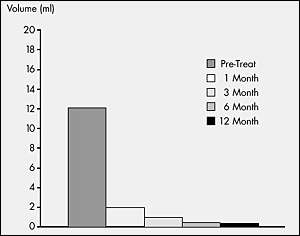
It is worth noting that PEI has been successfully used to treat hyperthyroidism in a pregnant woman with a toxic adenoma 23 . It has been recently reported that PEI treatment induces changes in radioiodine kinetics: cured patients have normalization of protein bound 131 I and show disappearance of adenoma on scintig-raphy; biological half-life of radioiodine was shortened before treatment and normalized in 18 of 24 patients after intranodular ethanol injection 24 . Patients successfully treated by PEI showed a progressive reduction of intranodular blood flow up to its extinction after 6–12 months, as assessed by color flow Doppler sonography 25 . A peak of serum interleukin- 6 from the dam-aged thyrocytes a few minutes after ethanol injection has been reported 26 . Interestingly, a marked increase of serum thyroglobulin after PEI treatment has been noted while serum FT 4 levels were only slightly increased 15 . The peak of serum thyroglobulin was progressively less evident after subsequent ethanol injections. This effect probably reflects the coagulative necrosis induced by ethanol. Finally, in some cases induction of Graves’ disease is seen after PEI treatment for toxic adenoma 27,28 . Thyroid cysts Drainage of cysts is often followed by recurrence, and definitive treatment is thus required. In the past, sclerosing substances including tertracycline have been used with poor results 29 . The prerequisite for PEI treatment of thyroid cysts is a benign cytology. In one study, PEI was proven to be better than aspiration alone in the reduction of volume of solitary cysts 16 ; in another study 11 recurrence was observed only in 5 % of patients treated by PEI, and a reduction of the volume was observed in all patients (Fig. 5). Figure 5:
Solitary cold solid nodules of the thyroid , with or without associated goiter, are a frequent finding in the general population, mainly depending on sufficient iodine intake of the residing area; they are managed by L-T 4 suppressive therapy or by surgery. Cytologically benign nodules can be treated by L-T 4 therapy, usually without much effect; unresponsive nodules may be observed over time or treated by surgery. Few studies reported a reduction of nodular volume of about 50 % after PEI treatment of a solitary cold solid nodule 30–32 ; in one study the efficacy of L-T 4 therapy was compared with PEI 31: nodule shrinkage was reported in about 50 % of PEI treated patients at variance with L-T 4 treated patients in whom nodule volume did not change significantly, thus suggesting that PEI might be effective in reducing the volume of benign cold solid thyroid nodules. However, it is well known that the majority of cold solid nodules are in the context of a multinodular goiter; it is our opinion that PEI treatment of the predominant nodule within a multinodular goiter will not avoid the increase of the other nodules, hence reducing its clinical use. |