|
Heterogeneity is a main feature of multinodular
goitre. The clinical presentation and the progression
of the disease, as well as the appearence of
thyroid scintigrams may be most varied between
patients. Furthermore, histological and autoradiographical
studies have demonstrated excessive
heterogeneity of goitre tissue removed by surgery.
The majority of nodules and internodular tissues
are heterogeneous with widely varying appearance
of the follicles and with follicles and clusters
of cells within follicles having highly diverse
functional activity. Scattered necrotic areas, connective
tissue strands, cysts and even calcifications
may be found in longstanding multinodular
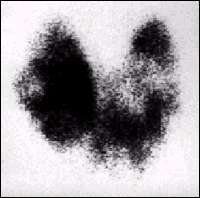
goitre. Ascintigram of a universially affected thyroid
in a hyperthyroid patient is shown in fig 4.
Figure 4:
The pathogenesis of this heterogeneity has been studied extensively by Studer and collaborators2. One mechanism may be amplification of natural heterogeneity of thyroid cells during generation of new follicles. However, this cannot explain more recent findings on the relation between clonal origin and heterogeneity of multinodular goitre. Heterogeneous nodules in a multinodular goitre may be of either mono- or polyclonal origin without significant difference in histological structure. Only few (monoclonal) nodules have the relative uniform histological structure of a ’true’ adenoma. Thus, even parts of the thyroid developing from a single cell (monoclonal origin), may become heterogenous during goitro-genesis. Multinodular goitre is basically a polyfocal and polyclonal abnormality. On top of this, more distinct nodules have developed, some of which are of monoclonal origin. Some of the more distinct hot and monoclonal nodules of a multinodular goitre harbour the same somatic point mutations activating the TSH receptor as found in solitary hot nodules of otherwise normal thyroid glands |