|
Severely ill "euthyroid" patients with low total serum T4 concentrations,
usually have normal or high free T4 estimates by direct equilibrium
dialysis, Amerlite MAB, and SPAC-ET methods while free T4 values
are frequently reduced by other methods (Figure 3) (3-5). Tracer equilibrium
dialysis underestimates free T4 values in severely ill patients
with reduced serum hormone binding (4,5) (Figure 1). By tracer ultrafiltration
methods, free T4 values were decreased (21), normal (22) or
elevated (19,23) in sick sera in which total T4 concentrations
were reduced to 41% to 73% of normal mean values, presumably due to methodological
variations.
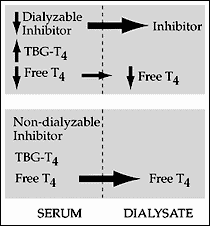
Despite normal or elevated free T4 levels by direct equilibrium dialysis in the majority of patients with nonthyroidal illnesses (4,5) (Figure 1), 31% of 175 patients with chronic renal failure had reduced free T4 levels by direct equilibrium dialysis (24). In addition, 80% of these patients also had reduced free T4 values by the Amerlex-MAB method (24). For both methods, serum free T4 correlated inversely with serum creatinine (24), suggesting a relationship to severity of illness. In another study, free T4 estimates by tracer ultrafiltration were within the normal range in 100% of critically ill and 100% of hemodialysis patients although mean values were reduced (21), while by tracer equilibrium dialysis 11% of hemodialysis patients had elevated values and 5.6% had reduced values (21). This variation is not readily explained. Dialyzable inhibitor(s) of T4 binding in uremic serum could explain inappropriately low free T4 levels by direct equilibrium dialysis in chronic renal failure patients (Personal communication Dr. JC Nelson, Loma Linda University, California) (18) (Table 1). As depicted in Figure 6, a dialyzable inhibitor in uremic serum would cross the dialysis membrane and be diluted in dialysate, normalizing T4 binding to serum carrier proteins, thereby, reducing free T4 levels in serum and dialysate. Indeed, serum concentrations of 3- carboxy-4-methyl-5-propyl-2-furan propanoic acid (CMPF), indoxyl sulfate and hippuric acid are markedly elevated in uremic serum, and indoxyl sulfate and hippuric acid are dialyzable in vitro (25). Figure 6:
Further, salicylates and salsalate are dialyzable, and salicylate ingestion results in underestimation of serum free T4 values by direct equilibrium dialysis compared to a tracer ultrafiltration method using minimally diluted sera (18). Other weak inhibitors of T4 and T3 binding to serum carrier proteins such as furosemide, dilantin and some nonsteroidal agents (Table 1) are diluted by some methods and consequently may also cause underestimation of free hormone values. In contrast, heparin therapy increases the free fraction of T4 when measured by equilibrium dialysis more than by ultrafiltration, due to liberation of free fatty acids during the in vitro dialysis procedure, which then displace T4 from binding proteins (18,20). Circulating free T4 concentrations would appear to be normal or elevated in the majority of patients with nonthyroidal illnesses, with exceptions being patients receiving pressor doses of dopamine, and those with concurrent hypothalamic, pituitary or thyroid disease (1-5). Since free T4 is the primary substrate for reverse T3 production, normal reverse T3 production rates in critically ill patients with reduced total T4 concentrations indicate normal free T4 availability in vivo (1-3). Thus, free T4 methods which provide normal or increased free T4 estimates in sera from sick patients without concurrent hypothyroidism would appear to most accurately reflect the in vivo state. |