|
Serum TSH and free T4 estimates are altered
more frequently by non-thyroidal illnesses than by thyroid
diseases in sick patients (9). Serum TSH values may be
transiently increased or reduced without reciprocal changes in
free T4 values, and free T4 values by direct equilibrium dialysis
are frequently elevated without reductions in TSH, and may be
artifactually reduced in critically ill patients and those with
end-stage renal failure without
elevations of serum TSH levels (8,10). Thus, in sick patients,
serum TSH levels may not reflect thyroid hormone status or
bioactive TSH. Elevated free T4 levels may be secondary to
reduced transfer of T4 from serum to tissue sites and relatively
reduced T4 clearance rates, and not to increased T4 production
rates. Conversely, reduced free T4 values may reflect in vitro
artifacts in methods which employ serum dilution or dialysis. In
vitro reductions of free T4 values may result in misdiagnosis of
central hypothyroidism. Thus, a working knowledge of the
performance of free T4 methods in sera from patients with
nonthyroidal illnesses is essential to accurately interpret these
test values. Serum reverse T3 levels do not reliably
differentiate sick hypothyroid patients from euthyroid sick
patients (11), and are not clinically useful. Currently,
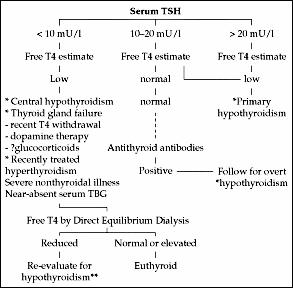
measurement of serum TSH and a free T4 estimate, and careful
clinical evaluation, are used to assess thyroid hormone status in
patients with nonthyroidal illnesses (Figures 1 and 2) (12). The
primary clinical goal is to accurately diagnose hypothyroidism or
hyperthyroidism in patients with concurrent nonthyroidal
illnesses, and to initiate specific treatment to minimize
morbidity and potentially mortality related to concurrent
hypothalamic, pituitary, or thyroid disease.
Figure 1:
Figure 2:
|