Signs and symptoms
Most patients are unaware that they have a thyroid nodule. You may notice an unusual lump in your neck, or a family member or friend may comment about it. However, most thyroid nodules are discovered during a physical examination for other conditions.
If you have been aware of your thyroid nodule for years, and it has not grown or changed texture during this time, it is probably not cancerous although it still must be evaluated . Also, if a lump seems to appear quite suddenly, it is more than likely a thyroid cyst (fluid filled nodule), which is rarely cancerous.
Most thyroid nodules do not make thyroid hormone. However, some
thyroid nodules function independently of the normal thyroid feedback
mechanism and may produce too much thyroid hormone. When this
occurs, the nodule is referred to as a toxic autonomously functioning
thyroid nodule; more than one toxic nodule is called a toxic multinodular
goiter. If you have either of these conditions, you can experience
the signs and symptoms of hyperthyroidism. For example, you may
feel tired, nervous, irritable, and hot as well as lose weight
and have difficulty sleeping.
It is not clear what causes thyroid nodules. However, it thought
that certain thyroid cells in a localized site of the thyroid
gland grow and divide faster than normal thyroid cells. When this
occurs in several sites at the same time, multiple nodules appear,
and the condition is referred to as a multinodular goiter.
There is an increased incidence of thyroid nodules in patients
who have been exposed to radiation. If you received radiation
treatments as a child for conditions, such as acne, tonsillitis,
or an enlarged thymus gland, you are at an increased risk of developing
thyroid nodules. Furthermore, these nodules are more likely to
be cancerous than nodules found in patients who did not receive
such treatments. Similarly, if you have received radiation therapy
to the head, neck, and chest area for cancer, such as Hodgkin's
disease, you are at a greater risk of developing thyroid nodules.
During a physical examination, your physician will often begin
by looking at a your neck to see if it appears swollen or lumpy.
By gently pressing his or her fingers along your neck, he or she
can sometimes feel a thyroid nodule and determine its size, as
well as evaluate the texture of the entire thyroid gland.
In order to determine if your thyroid nodule moves or stays in
one place, your doctor may ask you to swallow several times to
observe or feel the movement of the thyroid gland and nodule.
Although laboratory tests cannot determine whether a nodule is
cancerous, they are important for an accurate assessment of the
thyroid gland. Tests that measure the amount of thyroid hormone
and TSH in the bloodstream will indicate if your thyroid gland
is functioning properly or if you are either hypo- or hyperthyroid.
If you have a family history of thyroid cancer, your physician
may order a test that measures the amount of calcitonin in your
blood. High levels of this hormone are produced by medullary thyroid
cancer, an uncommon form of thyroid cancer that can run in families.
The most important and definitive test to determine whether a
thyroid nodule is cancerous is the fine needle aspiration biopsy.
This is safe, relatively painless procedure that is usually done
in an endocrinologist's, surgeon's, or pathologist's office. Your
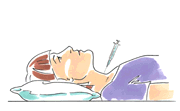
physician will insert a very thin needle into the thyroid nodule
several times and withdraw thyroid cells and fluid into an attached
syringe. These samples are sent to a cytology laboratory for analysis.
You can receive one of the following four results:
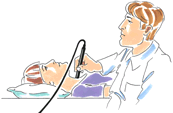
Thyroid ultrasound cannot determine if thyroid nodules are cancerous
or non-cancerous, but it can be a helpful diagnostic tool for
identifying and measuring thyroid nodules as well as determining
their structure. This is a painless procedure that forms a picture
of the thyroid gland by bouncing sound waves off of it.
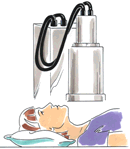
Thyroid imaging will determine how your thyroid nodule is functioning.
If your physician suggests this procedure, you may take either
a liquid or pill containing a small amount of radioactive iodine,
wait up to twenty-four hours, and return for imaging under a gamma
camera. In hyperthyroid patients, a radioactive iodine uptake
may be performed to determine how much iodine is "taken up”
by a nodule and surrounding thyroid tissue.
Hot nodules
If your nodule takes up more of the radioactive substance than
the surrounding thyroid tissue, it is called a hot nodule. Hot
nodules can become overactive, causing hyperthyroidism, but they
are seldom cancerous.
Warm nodules
If the thyroid nodule takes up the same amount of radioactive
iodine as the surrounding tissue, it is called a warm nodule.
Like hot nodules, warm nodules are rarely cancerous.
Cold nodules
If you have a nodule that takes up little or none of the radioactive
iodine, it is called a cold nodule. Approximately 90% of thyroid
nodules are cold; however, only 5% to 10% are cancerous.
Warning: Pregnant and nursing women should not have thyroid
imaging or any procedure using radioactive substances.
Treatment of thyroid nodules is based on test results and physical
examination. If your TSH is normal and your
thyroid nodule is shown to be cancer-free and not functioning,
your physician has two options. He or she may choose to monitor
the nodule for future growth without any treatment. Or, your physician
may prescribe a trial of levothyroxine to lower the pituitary gland's
production of TSH, the hormone that stimulates thyroid growth
and the production of thyroid hormones. Although some thyroid nodules
will shrink in response to this treatment, most remain the same
size.
If the result of the fine needle aspiration biopsy is unsatisfactory,
the aspiration should be repeated so that your physician will
be able to identify the type of cells contained in your nodule.
If your thyroid nodule is functioning independently and producing
excessive thyroid hormone, your physician will discuss the following
treatment options with you: surgery, radioactive iodine treatment,
or antithyroid drugs.
If you have a thyroid cyst, it may disappear after fine needle
aspiration because all or most of the fluid has been drawn out.
However, if the cyst continues to return after several aspirations,
it may need to be surgically removed.
If you have a single, cold thyroid nodule, and the biopsy is either
inconclusive or indicates the presence of cancer, your physician
will more than likely recommend surgery (thyroidectomy). Thyroid
cancer and its treatment are discussed in EM Pharma's ThyroCare™
brochure, "Thyroid Cancer”.
EM Pharma's ThyroCare™ brochures were developed to promote
a greater understanding of thyroid disease and the diagnostic
and treatment options available. If you have, or suspect you have,
a thyroid disorder, your physician is in the best position to
advise and treat you. We encourage you to discuss your questions
and concerns with him or her. Causes
Diagnosis
Physical examination
Laboratory tests
Fine needle aspiration biopsy
Thyroid ultrasound
Thyroid imaging with radioactive iodine


Normal Scan // Cold Nodule // Hot Nodule
Treatment