
No one single laboratory test is 100% accurate in diagnosing all types of thyroid disease; however, a combination of two or more tests can usually detect even the slightest abnormality of thyroid function. For example, a low T4 level could mean a diseased thyroid gland or a non-functioning pituitary gland not stimulating the thyroid function. Since the pituitary gland would normally release TSH if the T4 is low, a high TSH level is also present; this confirms that the thyroid gland (not the pituitary gland) is responsible for the hypothyroidism. If the T4 level is low and TSH is not elevated, the pituitary gland is more likely to be the cause for the hypothyroidism. Of course, this would drastically effect the treatment since the pituitary gland also regulates the body's other glands (adrenals, ovaries, and testicles) as well as controlling growth in children and kidney function. Pituitary gland failure means that the other glands may also be failing and other treatment than just thyroid may be necessary. The most common cause for the pituitary gland failure is a tumor of the pituitary and this might also require surgery to remove.
The older tests of thyroid function: Basal Metabolic Rate (BMR), basal body temperature, Achilles Heel Reflex Time, and measurement of Protein Bound Iodine (PBI) have been replaced by much more accurate thyroid function tests. Modern measurement of thyroid hormones is done by a new technique, radioimmunoassay (RIA), discovered by Dr. Solomon A. Berson and Dr. Rosalyn S. Yallow. They were awarded the 1977 Nobel Prize in Medicine for this discovery which revolutionized the study of thyroid disease as well as the entire field of endocrinology.
The following tests of the thyroid are those currently used today.
Most of the thyroid hormones in the blood are attached to a protein called thyroid binding globulin (TBG). If there is an excess or deficiency of this protein it alters the T4 or T3 measurement but does not affect the action of the hormone. If a patient appears to have normal thyroid function, but an unexplained high or low T4, or T3, it may be due to an increase or decrease of TBG. Direct measurement of TBG can be done and will explain the abnormal value.
Excess TBG or low levels of TBG are found in some families as an hereditary trait. It causes no problem except falsely elevating or lowering the T4 level. These people are frequently misdiagnosed as being hyperthyroid or hypothyroid, but they have no thyroid problem and need no treatment.
TRH test: In normal people TSH can be increased by giving TSH Releasing Hormone (TRH). A baseline TSH of 5 or less usually goes up to 10-20 after giving an injection of TRH. Patients with too much thyroid hormone (thyroxine or triiodothyronine) will not show a rise in TSH when given TRH. This "TRH test" is presently the most sensitive test in detecting early hyperthyroidism. Patients who show too much response to TRH (TSH rises greater than 40) may be hypothyroid. This test is also used in cancer patients who are taking thyroid replacement to see if they are on sufficient medication. It is sometimes used to measure if the pituitary gland is functioning. The new "sensitive" TSH test has eliminated the necessity of performing a TRH test in most clinical situations.
The test is performed by giving a tracer dose of radioactive iodine on an empty stomach. The iodine is concentrated in the thyroid gland or excreted in the urine over the next few hours. The amount of iodine that goes into the thyroid gland can be measured by a "Thyroid Uptake". Of course, patients who are taking thyroid medication will not take up iodine in their thyroid gland because their own thyroid gland is turned off and is not functioning. At other times the gland will concentrate iodine normally but will be unable to convert the iodine into thyroid hormone; therefore, interpretation of the iodine uptake is usually done in conjunction with blood tests.
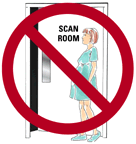
Two types of thyroid scans are available:
A rectilinear scan draws a picture of the gland to scale on paper. This is the only type of scan that can be used to measure the size of the gland. It is also best for identifying the location of nodules when needle biopsies are necessary. This type of scan is obtained by the scanner moving back and forth over the gland and takes approximately forty-five minutes to perform.
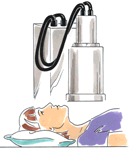
A camera scan is done using a gamma camera. The same camera as is used for scanning the liver, brain, etc. The camera operates in a fixed position and views the entire thyroid gland at once. This type of scan takes only five to ten minutes, but the image produced is not related to the actual size of the thyroid gland, and the gland looks distorted similar to a picture taken with a camera using a fisheye lens.
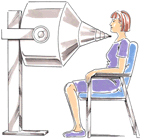
A rectilinear scan is the preferred method of scanning. In the 1990's, a new scanner called a Computerized Rectilinear Thyroid (CRT) scanner was introduced. The CRT scanner utilizes computer technology to improve the clarity of thyroid scans and enhance thyroid nodules. It measures both thyroid function and thyroid size. A lifesize 1:1 color scan of the thyroid is obtained giving the size in square centimeters and the weight in grams. The precise size and activity of nodules in relation to the rest of the gland is also measured.
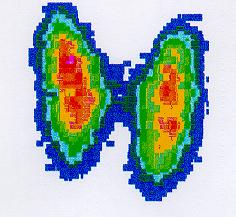
In addition to making thyroid diagnosis more accurate, the CRT scanner improves the results of thyroid biopsy. The accurate sizing of the thyroid gland aids in the follow-up of nodules to see if they are growing or getting smaller in size. Knowing the weight of the thyroid gland allows more accurate radioactive treatment in patients who have Graves' disease.
Thyroid scans are used for:
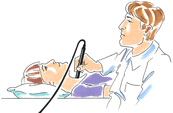
Ultrasound aids in performing thyroid needle biopsy by improving accuracy. More recently, ultrasound has become a primary way to follow patients who have been operated on for thyroid cancer to detect early recurrence.
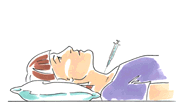
Thyroid needle biopsy is an office procedure and requires no anesthesia. Except for minor bleeding, no complications have occurred. The purpose of the biopsy is to rule out or confirm malignancy. About 20% of such biopsies are inconclusive and the thyroid pathologist cannot be certain if the tumor is benign or malignant. In such cases, a decision to operate is made upon other criteria. About 5% of biopsies do not yield enough cells to make a diagnosis.
In checking a person's thyroid gland, most tests need to be done while not taking thyroid medication. Thyroid antibodies, thyroid ultrasound, and thyroid needle biopsy are not affected by such medicine. The other thyroid tests measure both the thyroid we make and the thyroid we take. These tests will determine if there is too much or too little thyroid in the blood, but do not determine how much comes from the thyroid gland and how much comes from the thyroid pills.
Occasionally, it is important to measure a person's thyroid status who is on medications such as doing a thyroid scan on a patient who had surgery for thyroid cancer, or a person who was put on thyroid without adequate testing before being started on medication. Since Euthyrox or Synthroid, and most other thyroid pills behave exactly as normal human thyroid hormone, they are not rapidly cleared from the body as other medications are. Most thyroid pills have a half life of 6.7 days which means they must be stopped for five weeks (five half lives) before accurate thyroid testing is possible.
An exception to the long half life of thyroid medication is Cytomel - a thyroid pill with a half life of only forty-eight hours. Therefore it is possible to change a person's thyroid replacement to Cytomel for one month to allow time for his regular pills to clear the body. Cytomel is then stopped for ten days (five half lives) and the appropriate test can then be done. Usually patients, even those who have no remaining thyroid function, tolerate being off thyroid replacement only ten days quite well.